Types of Stamping Dies: How to Choose the Right Die for Production Volume, Precision and Cost
Choosing between different types of stamping dies affects tooling investment, production speed, dimensional consistency and long-term unit cost. A simple die may be enough for prototypes or short runs, while a complex progressive stamping die can become more economical for high-volume production.
The right choice depends on production volume, part geometry, tolerance, material, forming sequence and expected tool life. Buyers should therefore evaluate the entire manufacturing process rather than selecting a die only by initial price.
What Are the Main Types of Stamping Dies?
The main types of stamping dies include single-stage, compound, progressive and transfer dies, each suited to different production and part requirements.
Single-stage die: Performs one main operation per stroke, such as blanking, piercing or bending. It is suitable for simple parts, prototypes and lower-volume projects.
Compound die: Performs several cutting operations at one station in a single stroke, making it useful for flat parts requiring accurate internal and external features.
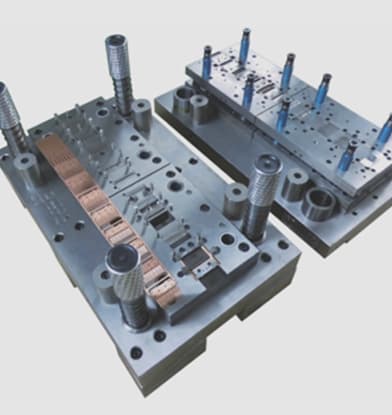
Progressive die: Uses multiple stations in sequence. Strip material advances automatically while each station performs part of the process.
Transfer die: Moves individual blanks between stations and is often used for larger or deeper formed parts.
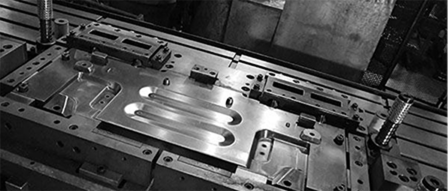
Orienson's tooling capabilities include progressive, compound and single-stage dies, allowing the tooling concept to be matched to the actual production requirement rather than forcing every project into one die type.
Progressive Die vs Compound Die vs Single Die: Key Differences
The main difference between these die types is how many operations are integrated and how efficiently they support automation and production volume.
| Factor | Single Die | Compound Die | Progressive Die |
| Operations | Usually one | Multiple at one station | Multiple across stations |
| Tool complexity | Low | Medium | High |
| Production speed | Low-medium | Medium | High |
| Automation | Limited | Moderate | High |
| Best volume | Low | Medium | High |
| Initial tooling cost | Lower | Medium | Higher |
A progressive stamping die usually requires the highest initial investment because feeding, pilots, strip layout and multiple stations must be engineered together. However, faster cycle time and reduced manual handling can lower unit cost when annual volume is high.
For buyers considering progressive die china, the key question is whether the required production volume and part complexity justify that higher tooling investment.
How Production Volume Affects Stamping Die Selection
Production volume influences stamping die manufacturing because the tooling investment must be balanced against cycle time, labor and expected unit cost.
For prototypes and short runs, single-stage tooling is often more economical because it is simpler and faster to build. Even if several separate operations are required, total project cost may remain lower when only a limited quantity is needed.
For medium-volume production, a compound die can combine multiple cutting operations in one stroke and reduce handling while maintaining dimensional consistency.
For long production runs, progressive tooling becomes more attractive because feeding and several forming steps can be automated. This is why stamping die cost should be evaluated over the expected production life rather than only by the initial quotation.
How Part Complexity and Tolerance Affect Stamping Die Design
Stamping die design becomes more demanding as part geometry, forming steps and tolerance requirements increase.
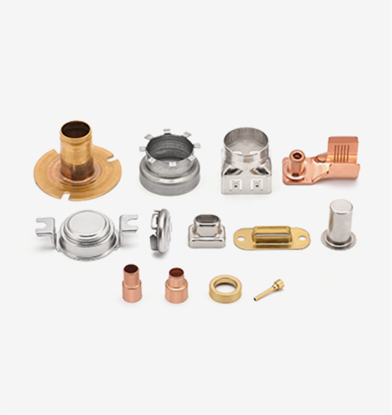
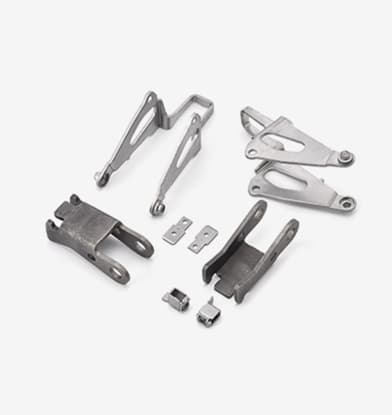
A flat bracket may need only blanking and bending, while a precision connector can require piercing, embossing, forming and final cut-off in a carefully controlled sequence.
Tolerance also changes tool construction. Tight-tolerance components require stable strip feeding, precise die alignment and controlled punch-to-die clearance. Material selection matters as well because stainless steel, copper alloys, spring steel and aluminum behave differently during blanking and forming.
For a precision stamping die, DFM should begin before tooling is manufactured. Early review can simplify part features, reduce unnecessary stations and lower maintenance risk.
How Tooling Cost and Lead Time Change the Best Die Choice
The lowest tooling price does not always produce the lowest production cost because cycle time, maintenance, scrap and annual volume also affect economics.
A simple die is usually cheaper to build, but it may require additional press operations or manual transfer. A progressive die costs more initially but can combine several operations into one automated process.
Lead time also matters. Complex tooling requires more design, machining, fitting and trial adjustment. For buyers, the better comparison is therefore:
tooling investment;
expected annual volume;
cycle time;
scrap rate;
maintenance frequency;
expected tool life.
These factors provide a clearer view of total stamping die cost than purchase price alone.
Which Stamping Die Is Best for Different Applications?
The best die type depends on production volume, part complexity and precision rather than industry name alone.
Automotive and electronics components often use progressive tooling because terminals, clips and connectors require repeated high-volume output. Medical and precision-electronics parts may place more emphasis on dimensional control and burr management, making a precision stamping die especially important.
Larger structural parts or deeper drawn components may favor transfer tooling because individual blanks can move between stations independently.
As a practical starting point: low-volume simple parts often suit single-stage dies; medium-volume flat components may suit compound dies; high-volume multi-operation parts often suit progressive dies; and larger deep-formed parts may suit transfer dies.
How to Choose a Stamping Die Supplier for Your Project
A reliable stamping die supplier should connect DFM, tool design, manufacturing, trial stamping and maintenance into one controlled workflow.
Before awarding a tooling project, buyers should evaluate:
DFM capability: Can the supplier identify manufacturing risks before toolmaking?
Tolerance experience: Has it produced similar precision components?
Tool material selection: Are steels and carbide chosen for expected wear?
Production capability: Can tooling and stamped-part production be supported together?
Lead time: Is the schedule realistic for the die complexity?
Maintenance support: Can wear components be repaired or replaced efficiently?
Orienson operates as a stamping die factory with in-house tooling design and manufacturing capabilities. For buyers, integrated engineering and production support can be more valuable than simply choosing the lowest tooling quotation.
Conclusion: Match the Die Type to Your Production Requirements
Choosing between the types of stamping dies should begin with production volume, complexity, tolerance and total cost.
Single-stage dies suit simpler low-volume projects, compound dies combine several cutting operations, and progressive dies are generally strongest for high-volume automated production. The correct stamping die design should also account for material behavior, maintenance and tool life.
The best die is the one that achieves the required quality at the most sustainable total production cost.
FAQ About Stamping Dies
What is a stamping die?
A stamping die is a precision tool used in a press to cut, bend or form sheet metal.
When should you use a progressive die?
It is usually suitable for high-volume parts requiring several sequential operations.
What is the difference between compound and progressive dies?
A compound die performs several operations at one station, while a progressive die distributes them across multiple stations.
Which stamping die has the lowest initial cost?
Single-stage dies generally have lower initial tooling cost.
How does production volume affect die selection?
Higher volumes can justify more complex automation because tooling cost is distributed across more parts.
What information should I send to a stamping die supplier?
Provide drawings, material, thickness, tolerances, annual volume and surface or assembly requirements.

 English